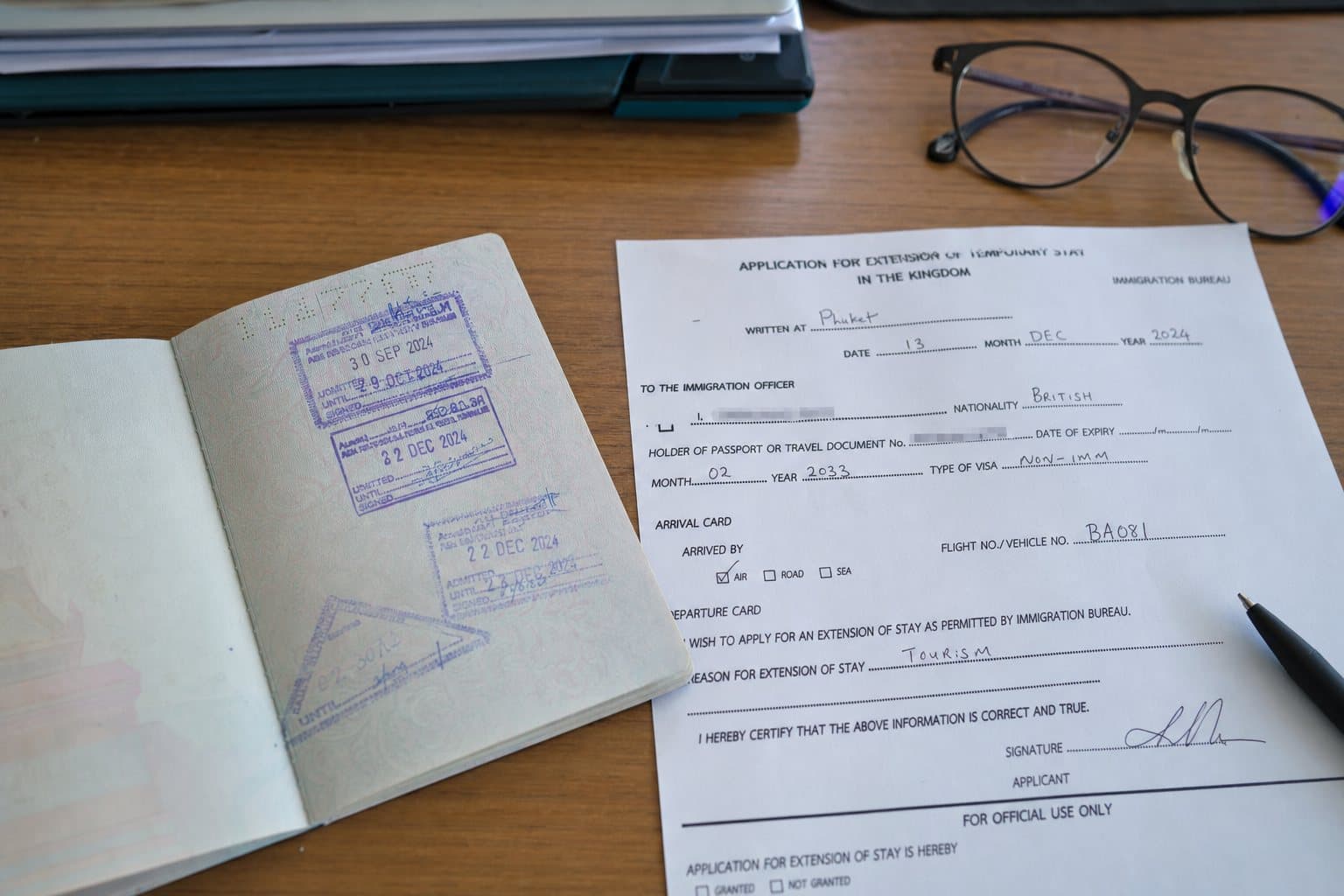
Non-Immigrant O (Retirement) and the annual extension
Last reviewed 1 August 2026
The route most retirees end up on. You enter or convert to a Non-Immigrant O visa on the grounds of retirement, then apply each year at your local immigration office for a further extension of stay.
Likely audience: Over-50s who intend to live in Thailand more or less permanently and are comfortable dealing with a local immigration office once a year.
Advantages
- +Well-established route that immigration offices deal with every day
- +No requirement to buy an insurance policy on every version of this route — check the current rule for your application type
- +Can usually be extended year after year while you continue to meet the criteria
Drawbacks
- −You deal with immigration in person, and requirements can vary between offices
- −Money must usually be seasoned in a Thai bank account for a set period before and after applying
- −90-day reporting and re-entry permits become part of your routine
Non-Immigrant O-A (Long Stay)
Last reviewed 1 August 2026
Applied for from your home country before you travel. Grants a longer initial permission to stay than a standard entry and is aimed squarely at over-50s planning a long stay.
Likely audience: Over-50s who prefer to arrange everything from home before flying, and who can satisfy a police check and medical certificate.
Advantages
- +Arranged in your home country, so you land with permission already in hand
- +Multiple-entry versions can allow a long total stay from one application
- +Money can usually be held in a home-country account for the application
Drawbacks
- −Health insurance meeting specific cover levels has been a requirement on this route — confirm the current cover levels, which have changed before
- −Police clearance certificate and a medical certificate are typically required
- −Insurance requirements can be hard or expensive to meet if you are older or have pre-existing conditions
Non-Immigrant O-X (Long Stay, 10 year)
Last reviewed 1 August 2026
A long-horizon retirement visa open to nationals of a limited list of countries, with substantially higher financial requirements than the O-A.
Likely audience: Over-50s from an eligible country with significant liquid assets who want to reduce how often they deal with immigration.
Advantages
- +Designed for a very long stay from a single application
- +Fewer repeat applications than the annual extension route
Drawbacks
- −Only open to nationals of a specific list of countries — check whether yours is on it
- −High financial thresholds, with money typically required to be moved into and kept in Thailand
- −Insurance and reporting conditions still apply
Destination Thailand Visa — Workcation
Last reviewed 1 August 2026
A multi-year, multiple-entry visa for remote workers and digital nomads employed by or contracting with businesses outside Thailand. Each entry gives a long stay that can typically be extended once.
Likely audience: People still earning remotely — consultants, contractors, semi-retirees with a part-time client base — who want long stays without the retirement financial tests.
Advantages
- +No age requirement
- +Multi-year validity with multiple entries
- +Financial evidence is generally lower than the retirement routes
Drawbacks
- −You must leave and re-enter (or extend) at the end of each permitted stay
- −Evidence requirements for remote employment vary by embassy
- −It is not a retirement visa and it is not a path to permanent residence
Destination Thailand Visa — Thai Soft Power activities
Last reviewed 1 August 2026
The same visa, applied for on the basis of a qualifying activity in Thailand: Thai language or cookery courses, Muay Thai training, sports, or medical treatment.
Likely audience: Long-stay visitors who are not working remotely but are enrolling on a course, training, or receiving planned medical treatment.
Advantages
- +Opens the DTV to people who are not remote workers
- +Genuinely useful if you were going to study Thai or take treatment anyway
- +Same long multi-entry structure as the workcation route
Drawbacks
- −You need real evidence of enrolment or a treatment plan
- −Course and clinic paperwork must satisfy the embassy you apply to
- −Not a retirement route, and not intended for people simply wanting to stay on
Destination Thailand Visa — Dependants
Last reviewed 1 August 2026
Allows a spouse and children of a DTV holder to apply on the same basis, so a couple can plan a long stay together.
Likely audience: Couples and families where one partner qualifies for the DTV.
Advantages
- +Keeps a couple on the same visa timeline
- +Avoids one partner falling back on tourist entries
Drawbacks
- −Dependant status is tied to the main applicant
- −Relationship evidence — marriage certificate, birth certificates — is required
- −Additional savings evidence may be expected
Long-Term Resident (LTR) visa
Last reviewed 1 August 2026
A premium long-stay visa administered by the Board of Investment with several categories, including a Wealthy Pensioner track aimed at retirees with a substantial pension income.
Likely audience: Higher-income retirees who want a long visa with fewer immigration visits and are comfortable with a documentation-heavy application.
Advantages
- +Long validity with a renewal structure, rather than an annual queue
- +Reporting obligations are lighter than the annual extension route
- +Includes a digital work permit pathway on some categories
Drawbacks
- −High income and/or investment thresholds
- −Health insurance or a substantial deposit is required
- −Application is document-heavy and can take time
Thailand Privilege (formerly Thailand Elite)
Last reviewed 1 August 2026
A paid membership programme that comes with a long-stay privilege entry visa and concierge services. You are buying convenience rather than meeting a financial test.
Likely audience: People who would rather pay a substantial one-off fee than deal with financial seasoning, annual extensions and immigration queues.
Advantages
- +No age or income requirement — membership is the qualification
- +Airport and immigration assistance included at most tiers
- +Removes the annual extension routine
Drawbacks
- −A large upfront cost with no refund of the value if plans change
- −Membership tiers, prices and benefits have been restructured before
- −It does not grant the right to work
Marriage and family routes
Last reviewed 1 August 2026
If you are married to a Thai national, or have a Thai child, there is a separate extension route with different financial requirements from the retirement one.
Likely audience: People married to a Thai national, or with a Thai child, particularly those under 50 who cannot use the retirement route.
Advantages
- +Financial requirements are generally lower than the retirement route
- +Available under 50
- +Can be combined with a work permit in some circumstances
Drawbacks
- −More paperwork, and home visits or interviews are common
- −Your status depends on the relationship continuing
- −Requirements can vary noticeably between immigration offices
Tourist entry and short stays
Last reviewed 1 August 2026
Visa exemption entries and tourist visas are the sensible way to test Thailand before committing to anything longer. They are not a long-term living strategy.
Likely audience: Anyone in the research phase who should spend a rainy season in Thailand before selling anything at home.
Advantages
- +Simple, quick and cheap
- +Ideal for two or three long trips before you decide
- +No financial seasoning or insurance hoops for a short visit
Drawbacks
- −Repeated back-to-back entries attract attention at the border
- −No security — entry is at the discretion of the immigration officer
- −Not a foundation for renting long-term, buying, or arranging healthcare